“The utility of art education to address powerful issues, generate
meaningful analysis, and provide compelling instruction demonstrates the
educative value that the study of such potent imagery can facilitate. The
impact of instruction that employs both inquiry and production processes
teaches children to constantly question, evaluate and address that which they
see. Such pedagogy not only validates the importance of art education, but also
demonstrates its indispensability.” – Green, 2004
Studying Violent or Controversial Art in the Classroom
The following lesson plan has been developed to
incorporate current literature which both discusses the dangers and the purpose
of using violent imagery in the Art classroom to help students develop higher
level thinking skills and become conscious consumers of all media.
What do we know about exposing students to violent images?
Since we know exposing children to violent images
has long-lasting effects on well-being (exposure has been shown to increase
crime, violence and aggressive behaviours), some would say it is never
appropriate for teachers to share violent images in class. In her article, “Reading
Violent Images”, Gaye Green argues that the Art classroom is the perfect place
to expose children to violent images. She suggests that the Art classroom is a
safe place because there is an instructor who is whose purpose to provide
students with a guided opportunity to deconstruct, make meaning and build
skills needed to become a critical consumer of all media.
Who struggles with violent images?
Green points out that some teachers opt not to
show students controversial images in their classes despite being aware of the
benefit of doing so. Some of the more popular reasons cited were the sheer
volume of images making it difficult for teachers to determine which images
were “best”, some teachers felt uncomfortable with talking about the
controversy with their administration and student’s parents while others felt
they lacked the art history knowledge to professionally tackle a controversial
theme.
One additional struggle for teachers is that
critique often takes place in the classroom during discussion and it is
difficult to assess and provide authentic feedback to students on ways to
improve as well as track their skill achievement over time. Teachers need to
provide students opportunities to not only critique works but also find
creative ways to assess their skills and skill growth.
What methods do we know are effective?
Based on Green’s research, she suggested that controversial
or violent images that are introduced in the classroom could categorized into
one of six common themes based on what the viewer perceives the artist’s intended
purpose was.
-
Glamorization of a celebrity
-
Minimization
-
False Justification
-
Trivialization
-
Desensitization
-
Misrepresentation
Green’s research also indicates that teachers
expose students to violent images in one of two ways.
The first method involves giving students a
chance to view a violent image and telling them which category it fit into and asking
them to discuss and defend if they think the image has been categorized
correctly.
The second method requires the teacher to present
the students with multiple images and ask them to categorize he images into
their corresponding themes and defend their opinions to their peers.
Both methods require modelling, scaffolding and
teacher support.
If we know there is risk involved, what enduring learning
outweighs that risk?
The enduring understanding that art teachers who
are using violent or controversial images in their classrooms should aim to
have students understand that anger is the contributing factor in producing
violent artwork. Throughout history, many artists have channeled their anger
via the creative process and have used art as an effective way to both deal
with their anger and express their emotions about a certain topic.
What makes art controversial?
Green provides a chart page 9 of the article that provides a
structured framework for Evaluating Violent Imagery. This framework could be
adapted/extended to all ‘controversial images’. It calls the evaluator/analyzer
to consider five key areas to decipher the information contained in the
controversial art work. It could be used as a supportive/guiding tool for
students beginning to analyze Art History and Controversial Images.
Methodology for Evaluating Issues
Raised by Violent Imagery
Image Context: How is this
image different from or similar to other images within
its particular genre/ movement/
style? What makes this particular image significant for interpretation?
World Contexts: Which world
realms such as sociological, Historical, psychological, aspects of
interpretation can facilitate political, scientific, Geographical, Religious,
literary, etc. could provide pertinent information for interpretation? What
resources are needed to conduct research into these areas? How will the
information garnered be evaluated for significance and accuracy?
Image Creator: Are
there writings/interviews of the artist that provide information regarding the
work? Are the creators' views supported by the image? Do the general public,
historians, critics, and/or other viewers agree with the creators' views? Do
these individual perceptions correspond with those of other groups? Is there
pertinent information regarding the creators' background, beliefs, experiences,
up bringing, etc. that might influence the making and subsequent viewing of the
image?
Image Content and Form: What is
contained in the image? How was the image constructed? How does the content and
form of this image compare with others that are similar? Which elements and
principles of design contribute to the significance of the image?
Viewer: Consider
the ramifications of individual viewers. Is there pertinent information about
the viewer that influences the viewing, i.e. religious beliefs, political
affiliation, gender, and economic status?
What background knowledge is needed to evaluate violent imagery?
In order to effectively evaluate violent imagery,
one must have existing knowledge of the period in art history when the image
was produced and an understanding of other controversial images and artists
from that time.
“Evaluating images that relate to violence is a
lengthy endeavor and one whose process is not primarily about securing answers,
but rather about engaging in the complexity of inquiry. Teaching students to
consider many aspects of interpretation can facilitate informed responses and
is a lifelong skill that can be used to analyze images in a variety of contexts.”
What makes art violent?
For the purpose of this lesson, we have decided
to focus on art that depict blood and/or torture.
Grade:
Nine Open Visual Art
Curriculum Standards:
B1.1 identify and describe their
initial reactions to a variety of art works (e.g., their emotional
reaction to a work such as Paul Peel’s After the Bath; their
first impression of a work’s mood,
subject, intent)
B1.2 identify, on the basis of examination, elements and
principles of design used in various art works, and describe their effects
(e.g., the use of value to enhance contrast between foreground and background;
the use of colour to contribute to mood, depth, and/or unity)
B1.3 interpret a variety of historical and/or contemporary
art works (e.g., prehistoric cave paintings, Egyptian tomb paintings, Claes
Oldenburg’s Shoestring Potatoes Spilling from a Bag) to identify their subject
matter and purpose and the meanings they convey
B1.4 use a variety of strategies (e.g., peer- and self-assessment,
formal and informal critiques,
small-group and class discussions) to identify and reflect
on the qualities of their own art works and the works of others, and evaluate the
effectiveness of these works
B2.2 identify ways in which various art works reflect the
society in which they were created (e.g., the cave paintings at Lascaux, the
pyramids at Giza, the Parthenon, the Qin terracotta warriors and horses)
The critical analysis process includes the following
aspects:
• initial reaction
• analysis and interpretation
• consideration of cultural context
• expression of aesthetic judgement
• ongoing reflection
Materials:
-A picture of a lemon for each student
-A picture of a house for each student
-A picture of a heart for each student
-Franciso Goya’s “Saturn Devouring His Son” (selected
because the Grade 9 English and Language Arts curriculum requires students to
explore Greek Mythology)
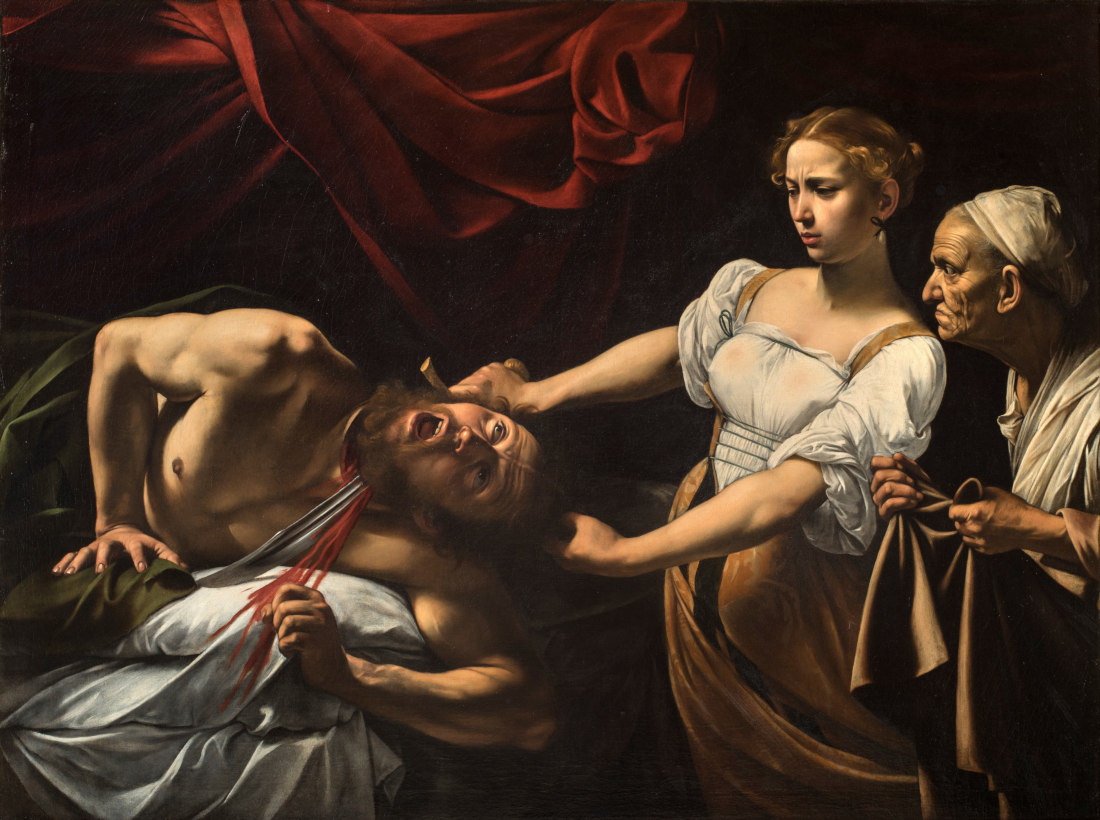
-Caravaggio “Judith Beheading Holofernes” (Selected as the “Religious”
piece to stir historical and religious debate)
- The Simpsons “Family Fight” (selected as the modern image)
-3 shoeboxes to be used as ballot boxes
-Worksheet
Input:
Explain to the students that they are going to be critiquing
art today. Display the three images around the room where they are clearly visible
to each student and give students time to consider each image. While they are considering
their initial reactions and being critical analysts, place a heart, a house and
a lemon cut out at each student’s desk and ask them to place their name on it. (5 minutes)
Next, ask the students to think about which one is their
favourite (heart), which one is they would most likely hang in their home
(house) and which one they don’t particularly enjoy (lemon). (5 minutes) Once
they have made their choices, they are to go and place their ballots in the
corresponding ballot boxes for each art piece.
Once students have had time to place their ballot, they
should return to their desk and record how they voted for each piece on the worksheet
below.
Franciso Goya’s “Saturn Devouring His Son
|
Caravaggio “Judith Beheading Holofernes”
|
Simpsons “Family Fight”
|
Ranking:
|
Ranking:
|
Ranking:
|
While the students are recording how they ranked each image,
the instructor should be tabulating the ballots the class cast.
Guided Practice:
The teacher should then lead a discussion about how the
students critiqued the work. Students may wish to record interesting points or take
jot notes from the discussion for the journal they will be required to write
later.
Sample guiding questions from the Curriculum Document the instructor
may find useful include:
• What is your first impression of this work?
• What does this work bring to mind?
• What does this movement suggest to you?
• What emotions does this work evoke?
• What puzzles you? What questions do you have?
• What connections can you make between this work and your
own experience or other art forms?
• What social, political, and historical events may have
influenced the artist in this work?
• What cultural movements, events, or traditions or other
works in the arts may have influenced the artist?
• What events in the artist’s life may have affected the
creation of the work?
As students work through these questions they may come to
realize they don’t have enough background information on some of the images or
the artists who created them. The teacher may ask students to take on the role
of researchers (as individuals or in small groups and report findings back to
the class)
The instructor should also ask the students if they view the artwork as violent?
What aspects of each piece make it feel or appear violent?
Do they think the piece is more acceptable now or in the time period it was created?
What makes something more or less violent (Contrast the cartoon to the more realistic paintings)?
Does familiarity play into comfort level?
Where would you expect to see these images? Would that be an appropriate place to display them in our current social climate?
Independent
Practice:
Following the introduction of this assignment, the teacher
will ask students to get into small groups, students will be asked to research
and prepare three images which are violent (contain blood or torture) and have
them approved by the teacher. Students will then sign up for a date where their
group will use their images to run the same activity with the images undergoing
the same analysis by their peers (House, Heart, Lemon) with the student group
who selected the images facilitating the discussion.
Follow Up:
Following each group’s presentation, the students in the
class must journal about one of the images they ranked. By the end of the four
violent image sessions, students must have written a critique about at least
one heart, one home and one lemon piece.